
How to Keep to Time Without Watching the Clock in the Treatment Room
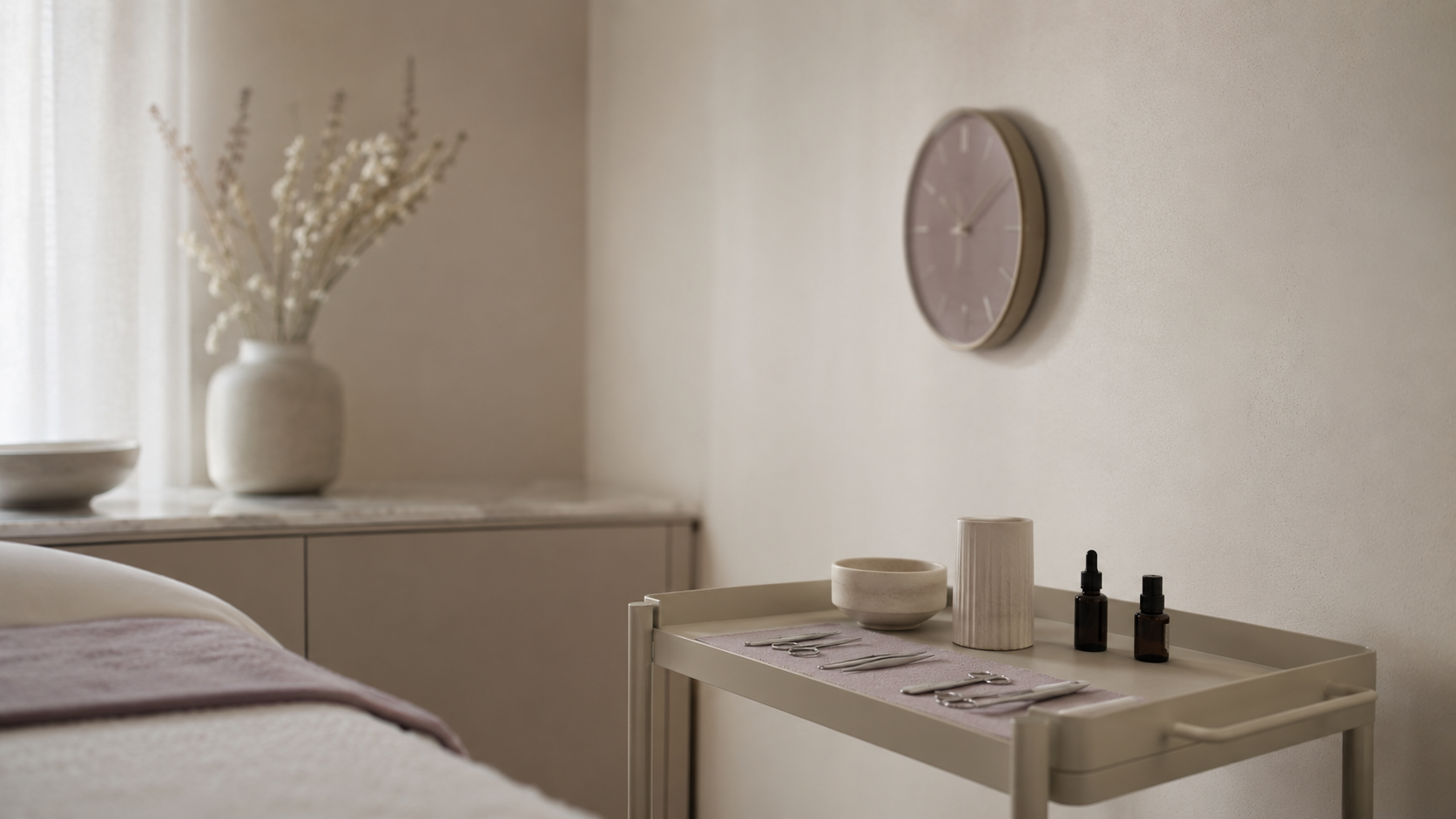
You know the moment. A client is mid-sentence, properly relaxed, and your eyes flick up to the wall. She catches it. Nothing about the treatment has changed, but the feeling of it has, and now she half-suspects you are counting down to the end of her appointment. That suspicion is hard to undo before she leaves.
The instinct to check is fair enough. Running late costs you something real, from the apology owed to the next client through to the unpaid minutes that pile up across a fully booked day. Most of us were never taught a better way, so we either run over or we glance, then glance again. There is a third option, and the practitioners who have found it make timekeeping look effortless. It rarely is a gift. It is a handful of habits, and you can build almost all of them on purpose.
The clock is the wrong instrument
Here is the awkward truth about the clock on your wall: it is not much use. It tells you how much time has passed, which feels like information and mostly is not. A client at minute 40 of a 75-minute service might be comfortably on track or badly behind, and the number on the wall will not tell you which. Elapsed time means something only when you have a reference point to measure it against.
That is why constant checking makes you anxious instead of in control. You look up, you see a number, the number has no context, so you look up again a few minutes later hoping it has somehow resolved into a verdict. It never does. A clearer clock will not fix this, and nor will a more frequent look. What fixes it is having reference points in place, so a single quick check actually tells you something worth knowing.
The most useful change you can make is to stop picturing a service as one long block of time ticking down, and start picturing it as a sequence of phases, each with its own target.
A lash full set divides cleanly enough: setup and consultation, eye pad placement, isolation and mapping, application, finishing and comb-through. A balayage has its own seams, from sectioning and application through development, toning and finishing. A gel manicure runs from prep to base and colour, the cure cycles, then top coat and cuticle work. Whatever you do, the service has natural joins.
Give each phase a time it should be done by. Now the question in your head stops being the vague "how long have I got left" and becomes the specific "should I have reached the toning stage by now." A milestone you have hit or missed gives you a straight answer. A running total never will. There is a second benefit too. You only need to check at the few transition points between phases, because those are the only moments when the answer can actually change.
Let processing time do the work
Beauty services come with built-in clocks that plenty of other professions would envy. Colour develops. Adhesive cures. Gel sits under the lamp, tint takes its minutes, masks need their time. None of that is dead time, and none of it needs a glance at the wall, because each stage carries its own alarm.
The timer you set for development chemistry is quietly reporting on your pace as well. Start it later than your milestone said you should, and the timer is now also warning you that the finish will be tight. So use the timers you already trust for the chemistry as pacing markers. A brow tint that needs ten minutes to process is also ten minutes to reset your station, prep the next step, or have the conversation that would otherwise stretch the finish and tip you over.
Time yourself before you trust yourself
Internal timing is a genuine skill. Therapists describe it as sensing the session rather than watching it, and it builds with repetition until it runs on its own. You can speed up that learning considerably.
For a fortnight, time your individual phases rather than your whole appointments. Services rarely run long evenly. The lost minutes nearly always pool in one or two specific phases, and treating the appointment as a single block makes that impossible to spot. A nail tech might find prep is reliably fine while cuticle work quietly overruns every single time. A colourist might find application is quick but the consultation drifts. Once you know your own pattern, you know which phase needs watching and which ones you can stop thinking about. You are not trying to turn yourself into a stopwatch. You are getting to know your own service well enough that the milestones start to feel instinctive.
Choose tools the client cannot read as impatience
The trouble with a wall clock or a wristwatch was never the timekeeping. It is that the client sees you consult them and reads the look as impatience. Therapists sorted this years ago with silent visual timers that shift colour as the minutes pass. The device sits in the practitioner's eyeline and means nothing to anyone else in the room.
The same thinking moves straight into a treatment room. A phone placed face down and set to vibrate at your phase checkpoints tells you to move on without a single visible glance. A clock positioned behind the client, at your natural eye level, can be read while you reach for product rather than through an obvious look upward. A playlist built to the length of a standard appointment gives you an ambient cue, so a familiar track tells you roughly where you are without any checking at all. Where you put the tool matters as much as which tool you pick. You are not hiding that time is passing. You are keeping your timekeeping from ever intruding on a client's sense that she has your full attention.
Find the minutes before the appointment starts
A surprising amount of overrun has nothing to do with the treatment. Every time you stand up to fetch something you forgot, or hunt for a tool that has wandered off the trolley, you spend time nobody budgeted for. On their own these pauses are tiny. Spread across hundreds of small movements in a day they add up, and because no single one is obvious, they go unexamined. Laying everything out within arm's reach before the client sits down is one of the simplest schedule fixes there is.
The consultation deserves the same attention. A decision made early does not have to be made late. Showing photographs rather than asking open questions moves a styling choice to the start of the appointment, where it costs you nothing. Offering a clear pick between two defined options does the same job. A digital intake form completed before arrival shifts the deciding out of the appointment altogether. Take the indecision out of the front half of a service and the back half stops running long.
Build the buffer in, then protect it
No amount of internal timing survives a schedule with no slack in it. Ten to fifteen minutes between appointments is the backstop that absorbs a client who arrives late or a set that needs a last-minute correction. Without it, one small overrun becomes every appointment for the rest of the day.
Client habits sit in the same category. A client who turns up with eye makeup still on, or heavy product to take off, or simply twenty minutes late, is a common and genuine source of overrun. A short pre-appointment message setting out what you need from her is worth more than any technique once she is in the chair. And when a client does arrive badly late, the honest answer is a shortened service or a reschedule. Quietly absorbing the loss into your own day, and into your next client's appointment, helps nobody. A buffer only works if you are willing to defend it.
What the client should notice
Handled well, none of this shows. The client leaves with no idea how closely you tracked the time, only a sense that the appointment was unhurried and finished more or less when it was meant to. That is the whole effect you are after, and it reads as calm even though it is really just structure.
Somewhere to start, then. Take the one service you do most often and map its milestones this week. Write down the time each phase should be finished by. Run a fortnight that way and the clock on the wall becomes something you can mostly leave alone.






Katie Hughes-Dawkins writes candidly about the pressures and rewards of leadership in aesthetics, drawing on two decades of experience building teams and running businesses. From hiring the right people to accepting that you won’t always be liked, she shares the lessons that have shaped her approach, including why kindness matters and when it’s time to put your own wellbeing first.