
What a Counterfeit Device Actually Costs You
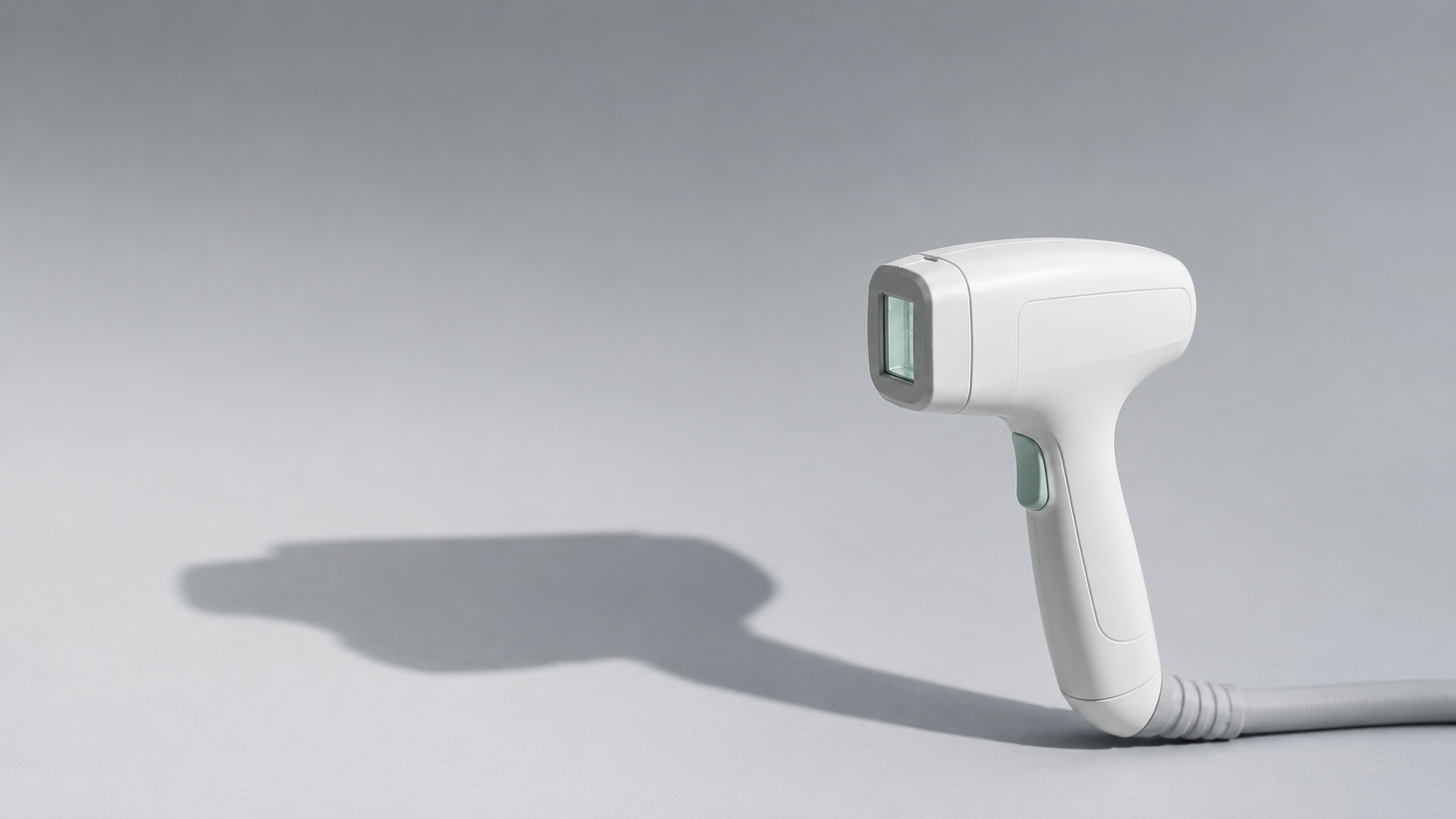
A laser burn complaint comes in. The clinic pulls the device file to send to the insurer. That is when a growing number of UK practitioners are finding out that the device they have been using is not what they thought they bought. By the time the insurer's coverage decision arrives, the practitioner is already exposed personally, and the protection they thought was in place turns out to be conditional on paperwork that does not actually exist.
Counterfeit devices are now a distinct category of risk in UK aesthetics, separate from the grey-market import problem we covered in a previous piece on the TikTok factory-tour videos that have flooded the business side of the platform. A grey-market machine is real, built in the same factory as the genuine product or close enough to it, just routed into the country in a way the regulator does not accept. A counterfeit is the thing pretending to be the machine. The exterior matches the genuine product. The interior, frequently, does not.
These devices are appearing on UK treatment beds through second-hand listings, social media direct messages, "ex-demo" sales, and resellers operating from short-lease addresses that disappear when a complaint lands. Practitioners are buying them in good faith, sometimes after seeing them demonstrated in a way that looked entirely convincing. The real bill arrives later, in a form most clinic owners have never been walked through.
What counterfeit actually means in this context
Three categories of fake device are circulating in clinics right now and they are not the same risk.
The first is the straight clone. A copy of a recognised system, branded with the original's name and logo, sold with paperwork that looks plausible. The user manual may even have been photocopied from the real product. The hardware is approximate, the electronics are not, and there is no quality system behind it.
The second is the rebadge. A generic device imported from a contract manufacturer, given a UK-sounding brand name, dressed in marketing that gestures at a clinical heritage that does not exist. This is the category most commonly mis-sold as "exclusive UK distribution" or "the OEM version" of a well-known machine.
The third, and arguably the most dangerous, is the gutted unit. A device that started life as a genuine piece of kit, then had its calibration files replaced or its safety hardware swapped out somewhere along the second-hand chain. These tend to surface through informal markets and through practitioners selling on after a clinic closure. The badge on the front is real. The machine behind it is not.
All three present the same practical problem. The settings on the screen do not correspond to what the laser or RF head is actually delivering. A "30 joule" pulse on a counterfeit fractional device might be 18 joules, or 55 joules, or vary unpredictably from shot to shot. Dr Priya Verma, founder of ART Clinic, summarises the clinical risk:
"This is one of the most concerning issues currently facing the aesthetics industry. We are seeing a rise in counterfeit and unregulated devices entering the market, often without appropriate CE marking, regulation or safety testing. These devices may deliver uncontrolled heat or incorrect wavelengths, significantly increasing the risk of burns, scarring, fat necrosis and nerve injury.
At the same time, there has also been a concerning increase in advanced laser procedures being performed by non-medics without appropriate training or oversight. Endolift, developed by Eufoton, is a regulated FDA-cleared technology and should only ever be performed by a qualified medical professional with advanced training in facial anatomy and laser safety."
The insurance trap
Most practitioners assume that if they hold a current medical malpractice or treatment risk policy, and they made the original disclosures honestly, they are covered. The wording of UK aesthetic policies has tightened to the point where that assumption no longer holds reliably.
Insurer endorsements on laser, IPL, RF, HIFU and energy-based device cover typically require, as conditions precedent to liability, several things at once. The device must be CE or UKCA marked, in the regulator's sense rather than the cosmetic sense. The practitioner must have completed manufacturer-specific training on the actual device, not a generic Level 4. There must be a current service report from a competent engineer. For higher-risk devices, MHRA registration must be in place. Some insurers add a further condition that the device is "suitably regulated and authorised for use and distribution in the UK", a phrase that quietly does a lot of work.
Counterfeit devices fail all of these tests, usually invisibly. The CE mark on the casing was not issued by a notified body, even if the four-digit number printed alongside it looks valid. There is no UK manufacturer or authorised representative, so manufacturer training is impossible. The service engineer who looks at the inside of the unit will not put their name to a service certificate once they see what is in there. And the device is, by definition, not authorised for distribution in the UK.
The gap only surfaces at claim. A client comes back with hyperpigmentation, scarring, a thermal burn or a more serious complication. Settlements on uncomplicated IPL or laser burn cases in the UK have been documented from the low thousands into five figures, with treatment risk policies written to limits of £1 million to £5 million precisely because catastrophic claims do happen. The insurer asks for the device documentation. The paperwork does not stand up. Cover is declined for breach of condition, and the client's solicitor amends the claim to plead the regulatory breach as evidence of negligence.
At that point, the practitioner is uninsured for the claim that has already been issued against them.
The corporate veil is thinner than people think
A common response to all of this is some version of "the clinic is a limited company, I will be protected by the corporate structure." It is worth setting that out properly, because the protection is partial and frequently misunderstood.
Limited company status protects shareholders from the company's contractual debts. It does not protect the individual who carried out the treatment from a personal injury claim. The client's solicitor will routinely name both the company and the treating practitioner as defendants, so that if the company has no insurance and no assets, the claim follows the practitioner personally.
Clinic owners who do not perform treatments themselves are not insulated either. Grubb v Shannon (2018) confirmed that a salon owner can be held vicariously liable for a self-employed practitioner working from the premises where the work is sufficiently integrated into the business. The rent-a-chair model that many clinics now run, with injectors and laser operators on self-employed arrangements, does not move the liability off the clinic in the way owners are sometimes told it does.
Where the device itself is counterfeit, the picture worsens. A claimant lawyer who can show that the clinic knowingly or recklessly used a non-compliant device will argue that the duty of care was already breached at the level of management decision-making, well before any question of clinical technique arises. That argument lands on directors. Knowingly placing a non-conformant medical device into use is, in principle, capable of criminal investigation under the UK Medical Devices Regulations 2002 and the Consumer Protection Act 1987. Prosecutions on this front are still rare, but the civil consequences are not.
Reputational damage runs in two directions
Personal reputation is the first to go. Once a complication appears in front of a journalist or a personal injury firm with a social media presence, the practitioner's name and the clinic name circulate in a way that is almost impossible to undo. Save Face and the JCCP publish complaint data, and the JCCP has previously reported a 400% increase in complaints in a single year. Practitioners who appear on those lists can expect to find themselves there for the long tail of the search index.
The second direction is industry-wide, and it is the part trade professionals tend to underestimate. Every time a counterfeit device causes a documented injury, the regulatory case for tighter controls gets easier to make. The Department of Health and Social Care has confirmed it will consult further in spring 2026 on the licensing scheme for non-surgical cosmetic procedures, and on putting the highest-risk procedures under Care Quality Commission regulation first. The Medicines and Healthcare products Regulatory Agency is widening the scope of the Medical Devices Regulations 2002 to pull more aesthetic devices into the regulated category. Practitioners using compliant equipment will pay the implementation cost of rules that were tightened in response to people using non-compliant equipment. The reputational risk that the industry will be regulated as if every practitioner is operating with a counterfeit fractional laser is real, and it falls on everyone, not on the buyer who created the case study.
Red flags from the patient side, and the practitioner side
Dr Verma's clinical summary of what the patient should be looking for is one of the cleaner statements of the issue, and it doubles as a checklist for any practitioner buying equipment or sizing up an unfamiliar supplier:
"From a patient safety perspective, key red flags include unrealistically low prices, absence of a formal medical consultation, inability to demonstrate practitioner qualifications or device authenticity, lack of genuine before-and-after photography, and treatments being carried out in non-clinical environments. Patient education and regulation within the industry have never been more important."
The procurement-side equivalents are worth being explicit about. A device sold for a fraction of the genuine equivalent, with no UK service contract attached, no manufacturer-direct training pathway, no written confirmation of the notified body, no demonstrable chain of custody back to the original manufacturer and no engineer prepared to certify it, is a device the insurer will not stand behind and the regulator will not accept. The paperwork that comes with a counterfeit can be very good. The supply chain underneath it cannot.
Practitioners who want to verify a device they already own can request the technical file and Declaration of Conformity from the supplier, cross-check the notified body number against the EU NANDO database or the UK approved bodies list, run the serial number against the manufacturer directly, and ask the MHRA via the Yellow Card scheme if a particular device or supplier is the subject of a current investigation. Suppliers who refuse to engage with any of those checks are providing the answer.
Price is the part of this conversation practitioners tend to start with. The harder question is whether the business behind the machine survives a complication when one comes. Once a counterfeit device is on the treatment bed, every part of the protection a practitioner has built up, the insurance, the limited company, the professional registration, the public reputation, is contingent on the device never causing harm. That is a long way short of a foundation a clinic should be standing on, and the people footing the bill when the protection fails are the practitioners, not the resellers who placed it there.







Katie Hughes-Dawkins writes candidly about the pressures and rewards of leadership in aesthetics, drawing on two decades of experience building teams and running businesses. From hiring the right people to accepting that you won’t always be liked, she shares the lessons that have shaped her approach, including why kindness matters and when it’s time to put your own wellbeing first.