
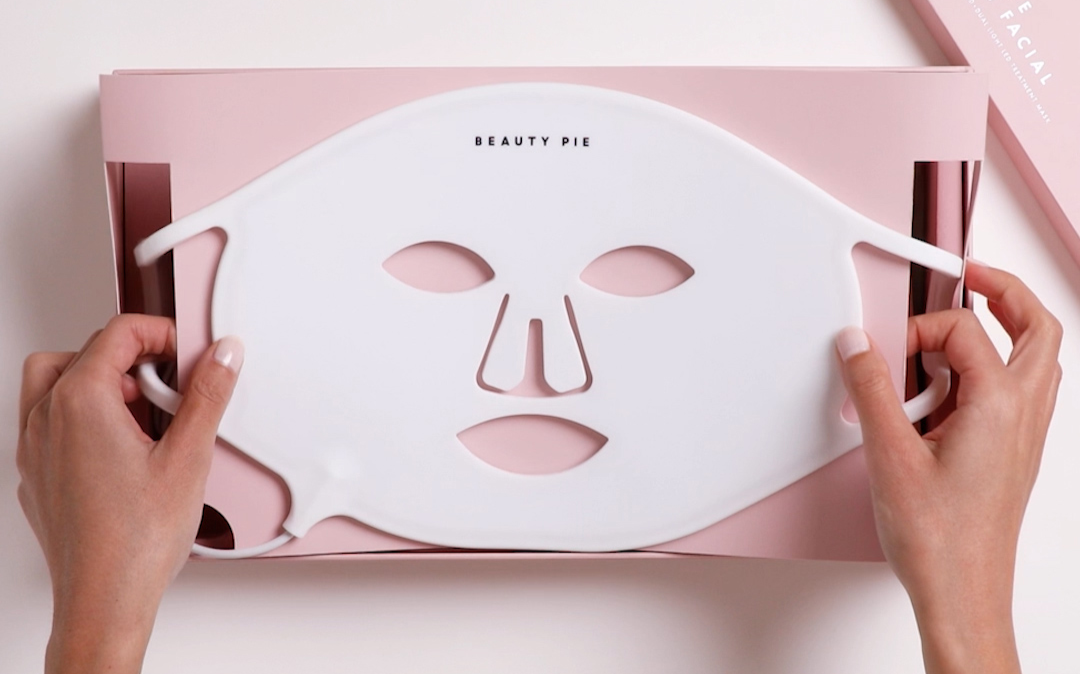
Beauty Pie has become the latest beauty brand to face regulatory action over the way LED skincare technology is marketed, after the Advertising Standards Authority upheld a complaint against a poster for its C-Wave Facial LED Treatment Mask.
The ruling, published on 10 June 2026, centred on a London Underground poster seen in December 2025. The ad showed an individual wearing an LED mask and carried the headline claim that the device was “clinically proven to reduce wrinkles in 4 weeks”. Smaller text stated that the results came from a four week study of 28 people aged 30 to 65.
The ASA concluded that the claim was misleading because Beauty Pie had not provided sufficient evidence to substantiate the specific message consumers were likely to take from the ad, namely that the mask had been scientifically proven to visibly reduce wrinkles within four weeks of use.
The ruling does not ban Beauty Pie’s LED mask from sale. It does, however, prevent the ad from appearing again in its current form and tells the brand not to state that the C-Wave Facial LED Treatment Mask is clinically proven to reduce wrinkles in four weeks unless it holds adequate substantiation for that claim.
Beauty Pie told the ASA that the mask was marketed exclusively for cosmetic purposes and was therefore not required to carry a UKCA medical device conformity marking. The company said the claim was supported by two product specific clinical studies on the C-Wave device, also referred to in the ruling as the FaceLITE device, as well as six peer reviewed clinical studies on what it considered to be equivalent LED technology.
According to the ruling, the first product specific study involved 28 participants using the device three times a week for four weeks. Before each LED treatment, participants also used cleansing pads and applied a hydrogel mask. Beauty Pie said the results showed a significant reduction in wrinkles, including a reduction in wrinkle smoothness and in wrinkle number and width. It also cited consumer self assessment, with 92% of subjects agreeing or strongly agreeing that their fine lines appeared less visible after four weeks.
ASA considered the sample size relatively small and said it had not seen analysis showing the sample was sufficient to produce reliable, statistically significant results. It also raised concerns that the study was not blinded, had no control or placebo group and included the use of additional skincare products not supplied with the LED mask sold by Beauty Pie. In the regulator’s view, this meant the reported improvements could not be clearly attributed to the LED mask alone.
The second product specific study involved 20 participants and did not use the hydrogel mask. Beauty Pie said that study showed an average visible reduction in lines and wrinkles of 20%, along with an average improvement in skin roughness of 14%. Again, the ASA found the evidence insufficient. It pointed to the small sample size, absence of a control group, lack of blinding and the fact that neither product specific study had been published or peer reviewed.
The regulator also reviewed Beauty Pie’s supporting evidence on other LED devices. Some of those studies involved clinical setting technology rather than a wearable home use mask, with different treatment formats, timings and delivery methods. Other studies involved handheld or under eye LED devices. The ASA considered these studies insufficient to prove the specific claim made in the ad, because consumers were likely to expect evidence relating directly to the C-Wave mask and to results after four weeks of use.
In 2025, the ASA also ruled against several LED mask brands over acne and rosacea related claims, finding that references to treating or preventing medical skin conditions could amount to unauthorised medicinal claims where devices were not properly registered or authorised.
The ruling is a reminder that claims about beauty products need to be calibrated more carefully. Cosmetic language such as supporting radiance, improving the appearance of skin, helping skin look smoother or contributing to a healthier looking glow may be easier to defend, provided the brand holds evidence proportionate to the claim. Stronger claims around wrinkle reduction, firming, pigmentation, redness, collagen stimulation or visible results within a defined timeframe require a higher standard of proof.

Hydrafacial UK has promoted Justine Stephens-Parker to Senior Head of Sales for the UK and Ireland, with a remit to support the company’s continued expansion across both markets.